
Somerset Projected and Actual Dates
A projected or working date is an estimate based on the sentence and facts then known. An actual release date records an event that already occurred. The difference matters in Somerset County because a court order, parole decision, and jail or prison movement are distinct records. A minimum sentence date marks the usual first point for parole consideration. It is not a release order. A parole grant authorizes conditional release only when its requirements are met, while the executed transaction proves that physical custody ended.
Pretrial detention works differently. A person held at Somerset County Jail before final sentence does not have a sentence-based projected date. Bail may permit release, a court may alter the order, or another detainer may keep the person confined. The UJS docket can show bail and court action, but it is not a jail movement log. Ask the jail or request the release transaction for the time and destination of an actual event.
A transfer is another key risk. Leaving Somerset County Jail for SCI Somerset, SCI Laurel Highlands, another jail, federal custody, or immigration custody ends the county jail episode but not confinement. A valid release record should be read with its disposition or receiving-authority field.
Find a Somerset Projected Release Date
Begin with the court sentence, not a date calculator. The certified order supplies the legal minimum and maximum terms and can show whether terms run at the same time or one after another. The docket also records later orders, resentencing, and revocation activity. Official credit and sentence administration remain with the proper custodian. A hand estimate can help frame a question, but it should never be presented as PA DOC’s calculation.
- Identify whether the person is at Somerset County Jail, SCI Somerset, SCI Laurel Highlands, another PA DOC institution, or a different custodian.
- Find the correct criminal docket and obtain the sentencing order. Check every relevant case because another term or detainer may control release.
- For a state case, search the PA DOC locator’s inmate side for present custody and its supervised side for an already executed release.
- Do not treat the supervised result’s
Release Dateas projected. That field appears for a person already released into current DOC supervision. - Ask PA DOC for an existing sentence-status calculation when an official working date is needed. Include the DOC number and a defined period.
- For a county sentence, use the sentencing court, Somerset County Jail, and local probation or parole process. No public county forecast tool was found.
- Confirm the event with the release transaction and receiving authority, then use notification services for a timely custody-change signal.
The PA DOC Inmate and Department Supervised Individual Locator is updated daily and excludes county-only detainees. It displays current state inmates and people currently under DOC supervision. It does not publish a historical released-person list.
The official locator image below documents the source and its public search interface.
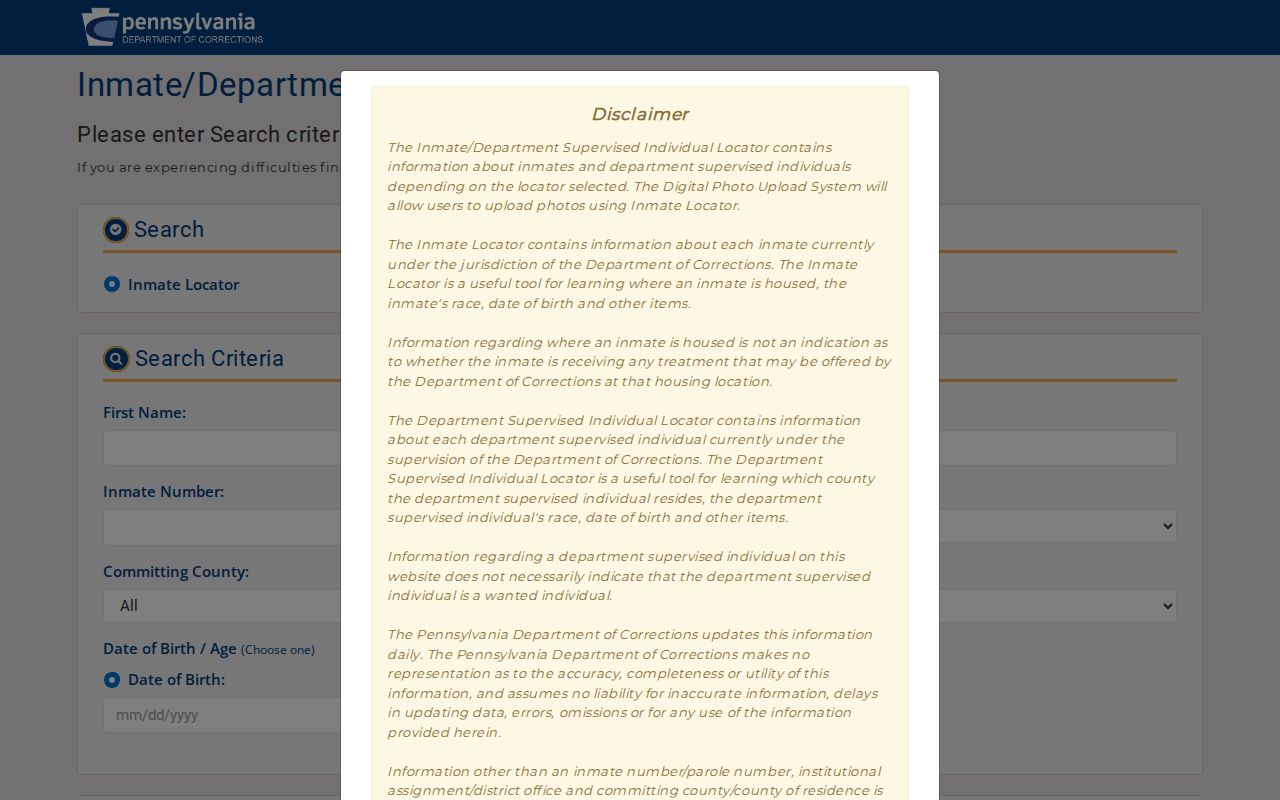
No projected, tentative, minimum, maximum, or controlling date field appears on that public locator. Its actual release date belongs to current supervised-person results.
The Somerset County released inmate search provides the separate custody trail for a person who may already have left a facility.
Note: A no-match result can reflect bad identifiers, another custodian, or full discharge; it does not establish a date.
Somerset Release Dates Under Pennsylvania Law
Pennsylvania generally uses an indeterminate sentence for total confinement. Under 42 Pa.C.S. § 9756, the court ordinarily states a minimum and maximum, and the minimum may not exceed half the maximum. The minimum is usually the first parole-eligibility point. Under 61 Pa.C.S. § 6137, the Board generally may not exercise parole discretion before the judicial minimum and must apply statutory criteria afterward.
There is no blanket Pennsylvania rule that every state prisoner serves 85 percent, and there is no universal state good-time subtraction. That federal shorthand should not be imported into a Somerset sentence. Pennsylvania’s Recidivism Risk Reduction Incentive, or RRRI, is a separate path for an eligible person. The official RRRI overview explains the program, while Title 61 sets eligibility exclusions and conditions.
Under § 4505, an RRRI minimum can use three-fourths of a minimum of three years or less and five-sixths of a longer minimum. Those fractions apply only in the statutory RRRI setting. Reaching that date does not make release automatic. Section 4506 adds conditions. Short Sentence Parole under § 6137.1 is another defined route and is not generic earned time.
Credit for qualifying time already spent in custody is governed by 42 Pa.C.S. § 9760. The court order and official calculation decide which custody counts and prevent duplicate credit. A dispute about credit should be resolved through the case and authorized legal channels, not by an unofficial calculator.
Why Somerset Release Dates Change
A working date can change when the legal terms, credited custody, parole decision, or release conditions change. Some changes affect only eligibility. Others prevent execution after a favorable decision. The record must show which event occurred.
| Factor | Effect on the date | Record to check |
|---|---|---|
| Custody credit correction | Changes the official minimum and maximum calculation when lawful credit is added or corrected. | Sentencing order and agency sentence-status record. |
| Concurrent or consecutive terms | Changes whether sentences overlap or run one after another. | Certified sentencing orders for all cases. |
| New sentence or detainer | May keep the person confined after one term or case permits release. | Dockets, warrant or detainer record, and receiving authority. |
| Resentencing or reversal | Replaces or alters the terms used in the calculation. | Later court and appellate orders. |
| RRRI or SSP eligibility | May create a distinct statutory release path if all criteria and conditions are met. | Sentence, DOC status record, and Board Action. |
| Parole refusal or conditions | Can move actual release beyond the minimum or delay a grant until requirements are complete. | Board Action and executed release record. |
| Rescission or recommitment | Can cancel a pre-release grant or return a released person to custody. | Board decision, docket, and DOC movement record. |
A maximum date also needs care. It is the judicial outer term as lawfully calculated, but other sentences or lawful action may remain. Maximum-out can end parole supervision for one sentence. That helps explain why a person may disappear from a locator limited to current supervision.
Confirm Somerset Actual Release Dates
PA SAVIN, powered by VINE, can provide a timely custody-change signal for Somerset County Jail, Pennsylvania state prisons, and state parole. Registration is most useful before an expected event. A release, transfer, or movement alert should be saved with its date and then confirmed with the custodian. VINE is not a certified historical release transaction and does not cover federal or immigration custody.
The county jail transaction is the best operational proof that Somerset County Jail’s custody ended. Ask for the release date and time, type or disposition, and receiving authority or destination when maintained. A court docket can explain the legal basis but may not record the handoff time. For PA DOC, request the existing final release or discharge transaction for the inmate number and period.
Use the Somerset County VINELink check to register for a named-person alert. If the event has passed, use the jail, DOC, docket, and records-request routes instead of expecting the alert service to reconstruct a public archive.
Note: “Released from” one facility describes that custodian only until the destination is checked.
Somerset Release Planning Before Parole
Somerset County’s documented monthly county-parole review shows why a mathematical estimate is incomplete. The county Intermediate Punishment Plan says an Institutional Parole Officer gathers information for review with jail leadership, the public defender, district attorney, President Judge, and probation. The review may consider conduct in the jail, work-release status, detainers, treatment, current or pending cases, and risk or service needs.
Before county parole, the officer and Coordination of Care Team discuss a reentry plan. The plan can include a proposed home, appointments to identified services, medication when needed, and a Resource Information Guide. These steps are more useful than an invented county calculator because they show what can remain unresolved after an eligibility point is reached.
A review date is not a hearing result. A home plan is not a release record. Detainers, pending cases, court authority, and completion of release conditions can still affect execution. For that reason, confirm a county case through the court, jail transaction, and local probation channel. State-prison parole follows the Pennsylvania Parole Board and PA DOC instead.
Request Somerset Sentence Calculations
When a public source lacks the needed field, request an existing record rather than asking the agency to solve a date question. For PA DOC, identify the person by DOC number, give a useful date range, and request the existing sentence-status calculation or final release or discharge record. The request should distinguish a forecast from an already executed release.
The PA DOC Right-to-Know service provides the official request route. It does not guarantee disclosure, and an agency need not create a new calculation or narrative. Relevant material may also be redacted under law.
The official request page is shown below as the fallback when the public locator cannot answer a Somerset projected-release question.
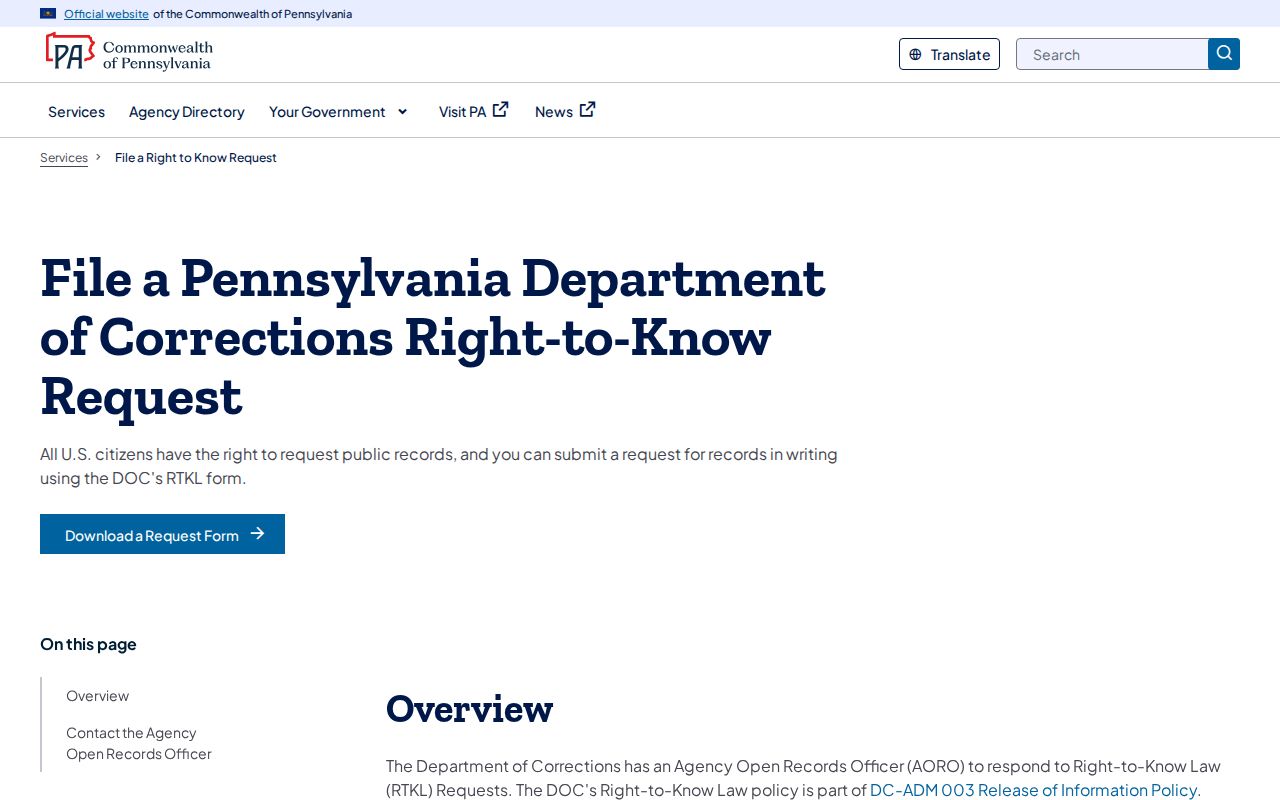
A focused request should seek the record that already exists. It should not ask PA DOC to certify a county-jail date or the county to calculate a state sentence.
County and court requests have different custodians. Somerset County’s open-records officer can address existing executive-agency jail records, while the Clerk of Courts handles judicial records under UJS policy. A request for the county jail transaction can name the booking episode, release date and time, disposition, and receiving authority if maintained. A request for the certified sentencing order goes to the court record channel. Neither office should be asked to interpret the other office’s record.
If state parole is central, identify the case-specific document as the Board Action. It may show a grant, refusal, deferral, or rescission, but access can be limited and the decision still does not prove physical release. Pair it with the PA DOC movement or release transaction. This record-by-record method is slower than a calculator, yet it preserves the difference between eligibility, authorization, and execution.